
Turn daily chores into worship🧹
The power of pure intentions
It’s frustrating how this dunya distracts us from what really matters.
Often, I wish I could withdraw from all worldly responsibilities and just focus on my akhirah - somewhere isolated, maybe in a hut far from everything.
But for most of us, that’s not realistic.
Sometimes I complain to someone close about it1, and they remind me: “Seek Allah’s reward in what you do, and it becomes worship.”
And I think that’s beautiful - the idea that we can live our lives and still be rewarded for it, pleasing Him through something as simple as changing our intentions.

Before we start, please keep in mind: Seeking Allah’s reward doesn’t transform impermissible actions into worship, nor does it excuse going against the Sunnah2!
We’re still accountable for our outward deeds - following the Shari‘ah is non-negotiable. But the permissible, everyday tasks we’re already doing can become acts of worship - when we perform them seeking Allah’s reward.
بسم الله والصلاة والسلام على رسول الله
Allah, subhanahu wa ta‘ala, said:
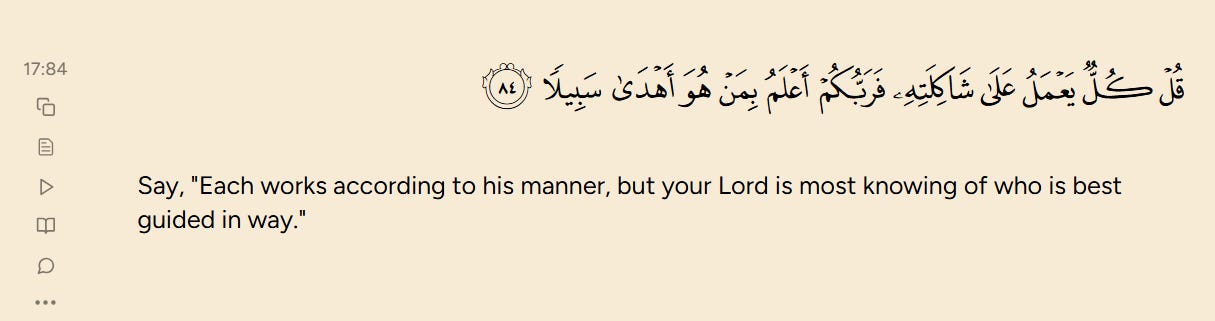
al-Hasan al-Basri, rahimahullah, said about “according to his manner”:
“على نيته”
“according to his intention.”
[Kitab az-Zuhd by Waki‘ (350)]
‘Umar bin al-Khattab, radiyallahu ‘anhu, narrated that the Messenger of Allah ﷺ said:
«إنما الأعمال بالنيات وإنما لكل امرئ ما نوى»
“Verily, deeds are according to intentions, and every person will get what he intended.”
[Sahih al-Bukhari (1), Sahih Muslim (1907)]
With the correct intention, ordinary and everyday actions can become ‘ibadah (worship)
Abu Mas‘ud, radiyallahu ‘anhu, narrated that the Prophet ﷺ said:
«إذا أنفق الرجل على أهله يحتسبها فهو له صدقة»
“If a man spends on his family hoping for Allah’s reward, it is counted for him as Sadaqah (charity).”
[Sahih al-Bukhari (55)]
Sa‘d bin Abi Waqqas, radiyallahu ‘anhu, narrated that the Messenger of Allah ﷺ said:
«إنك لن تنفق نفقة تبتغي بها وجه اللّٰه إلا أجرت عليها، حتى ما تجعل في في امرأتك»
“Indeed, you will not spend any spending seeking the face of Allah with it, except that you will be rewarded for it - even what you put (as food) into your wife’s mouth.”
[Sahih al-Bukhari (56)]
And Mu‘adh, radiyallahu ‘anhu, said:
“لكني أنام ثم أقوم فأقرؤه، فأحتسب نومتي كما أحتسب قومتي”
“But I sleep and then get up and recite it*, and I hope for Allah’s reward for my sleep just as I hope for His reward for my standing.”
[Musannaf ‘Abd ar-Razzaq (5959)]
*(i.e., his Juz’ from the Qur’an)
Sufyan reported from Zubayd (rahimahuma Allah), who said:
“يسرني أن يكون لي في كل شيء نية حتى في الأكل والنوم”
“It pleases me to have an intention in everything, even in eating and sleeping.”
[Kitab az-Zuhd by ibn al-Mubarak (195)]
Ibn al-Mubarak, rahimahullah, reported:
I heard Ja‘far bin Hayyan say:
“ملاك هذه الأعمال النيات؛ فإن الرجل يبلغ بنيته ما لا يبلغ بعمله”
“The foundation of these deeds is the intentions; for a man attains by his intention what he cannot attain by his action (alone).”
[Kitab az-Zuhd by ibn al-Mubarak (196)]
Allah has given us a way to turn every moment into an opportunity for reward.
Even by:
smiling at your Muslim brother or sister (brothers to brothers, sisters to sisters),
speaking kind words to your parents and fellow believers,
offering a glass of water to your parents,
helping with housework,
fulfilling your responsibilities toward your spouse,
cooking for your family,
feeding your children or pets,
studying with the intent to find work,
working to support yourself and your family,
taking care of your body (eating, sleeping, etc.),
brushing your teeth,
trimming your nails, and so on
→ for all of this we can be rewarded, in sha’ Allah.
Whether you’re a student, a woman at home, or a man working outside the house - wherever Allah has placed you, your daily life holds immense potential for reward.
Unfortunately, we are often careless and let these opportunities pass us by.
For every deed, our intention is essential. So let us pay attention to it and try to always purify it for Allah.
We have to do many actions every day anyway, so why not seek His pleasure through them?
Many non-Muslims speak of “living in the moment,” and we should try this too - but in a different way: by being present and aware that Allah sees us right now, and that, in sha’ Allah, we can please Him with what we do.
You’re already doing the work. Now just do it for Him, subhanahu wa ta‘ala.
Before any task, pause and purify your intention for Allah.
(such as: sleeping for strength in prayer, eating to take care of your amanah, working to provide halal income, doing things the way the Prophet ﷺ did, etc.)
May Allah purify our intentions and make our daily lives a means of drawing closer to Him. Amiin.
Subscribe to stay updated on new articles and courses:
Want reward for this? Share this article seeking Allah’s pleasure.
PS. If you spot any mistakes in the translations, please let me know!
By “complain,” I mean expressing the struggle of balancing dunya and diin.
Important Note: In the disclaimer above, when I say “going against the Sunnah,” I mean abandoning what is obligatory and going against the way of Ahl as-Sunnah wa-l-Jama‘ah - not leaving voluntary acts of worship. I’m not claiming that skipping a sunnah prayer or other recommended acts is sinful.